Stop saving. Start compiling.

KOMPL is an open source, self-maintaining LLM-wiki. It turns what you save into cited wiki pages, updates them as you save more, and answers your AI agent over MCP.

The problem

You save it all. Then it just sits there.

  • Saved things never get read

    Links, PDFs, threads and videos pile up in folders you don't open again.

    KOMPL reads every one for you. By your tenth save on a topic, it already sees the pattern across all ten, without you asking.

  • Every question starts from scratch

    Most tools wait for a question, then retrieval (RAG) pulls a few static chunks and does the same work again next time.

    KOMPL compiles at save time, so your agent reads compiled pages instead of raw chunks.

How it works

Import your saves. KOMPL compiles and keeps it current. You ask.

  1. 01

    Import and compile

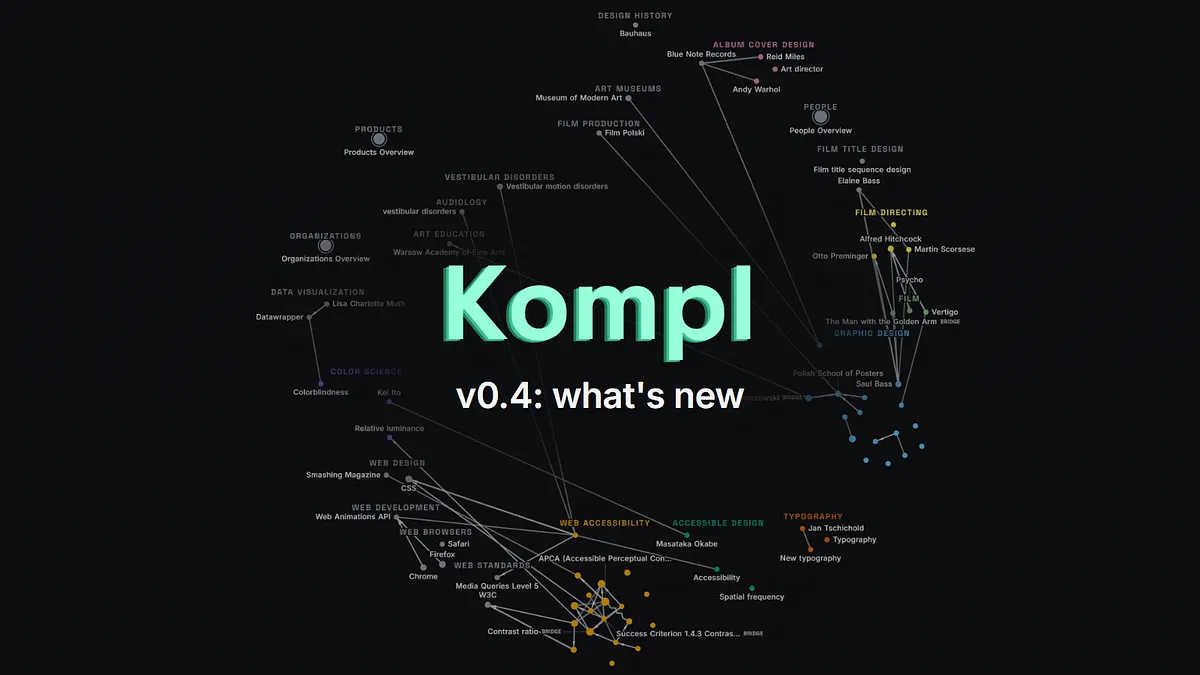
    Bring your sources in: a link, a PDF, a thread, a YouTube video, a bookmark export. KOMPL reads each source as it arrives and writes it into wiki pages that link to each other. Names and ideas that keep showing up get their own pages.

  2. 02

    It maintains itself

    Keep saving as you go. Each new source rewrites the pages it touches and marks what it updated, changed or added, so the wiki keeps itself current without upkeep.

  3. 03

    Ask and generate

    Your AI agent reads the compiled pages through KOMPL's MCP server. In Claude Code, Cursor or any MCP client, it can talk a topic through with you and make things from your wiki, like a brief or a style sheet, with numbered citations back to the sources.

Disputes and citations

Where sources disagree, it says so.

Sources contradict each other, and newer ones put older claims out of date. KOMPL notices, puts both sides on the page with their citations, records what changed and when, and leaves the call to you. Here is how that played out on one page, about the APCA contrast method.

01 / Two sources, two answers

What does APCA stand for?

Source 1

Accessible1

Source 2

Advanced2

Perceptual
Contrast
Algorithm

Disputed: full name

02 / KOMPL notices

It doesn't pick a winner.

A claim check compares claims from different sources. These two can't both be right, so the page records a disputed claim instead of quietly keeping one.

Full name

2 sources disagree

03 / Both sides, cited

The page shows both.

Each version stays on the page with its numbered citation, and each number links to the source it came from. You read both and check either one.

[1] Accessible Perceptual Contrast Algorithm

[2] Advanced Perceptual Contrast Algorithm
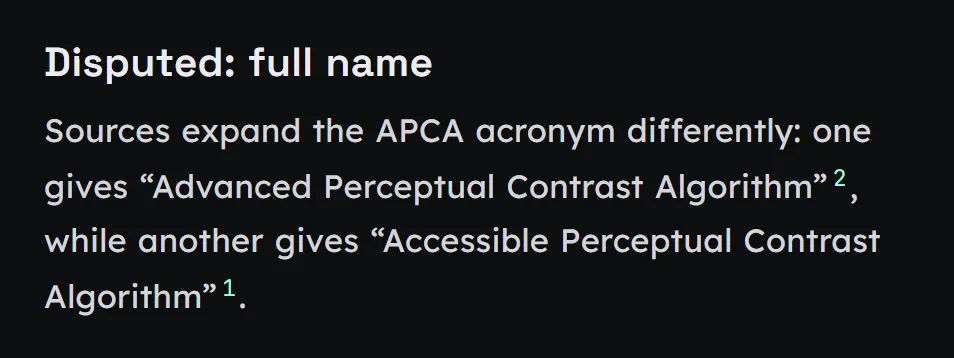
A 'Disputed: full name' section in KOMPL: one source expands APCA as 'Advanced Perceptual Contrast Algorithm' and another as 'Accessible Perceptual Contrast Algorithm', each with its citation number.

04 / What changed, and when

Changed: APCA's place in the WCAG 3 draft

Not every disagreement is a dispute. When a newer source updates a claim, the page keeps the dates, so you see how it changed.

  1. 2021

    The 2021 article described APCA as the visual contrast algorithm currently referenced in the WCAG 3 Working Draft3.

  2. 2022

    A 2022 article described APCA as the candidate contrast method for the future WCAG 3 guidelines1.

  3. 2024

    A 2024 update to that article states that APCA is not in the current draft and that the working group updates the draft about every six months3.

05 / You decide

Confirm or dismiss.

Each finding sits in the page's Disagreements panel with Confirm and Dismiss. The call is yours.
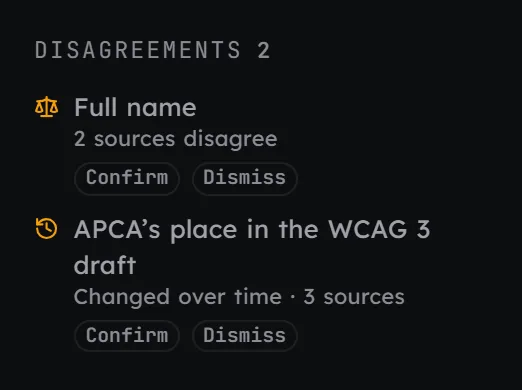
KOMPL's Disagreements panel with two findings: 'Full name', where 2 sources disagree, and 'APCA's place in the WCAG 3 draft', changed over time across 3 sources, each with Confirm and Dismiss buttons.

Watch it work, or read how it works.

Video · 4:53

A self-maintaining second brain your AI agent reads

In the video, 23 saved sources become 91 linked, cited wiki pages. Four more go in, and KOMPL updates the pages they're about, adds new ones and flags outdated links, then an AI agent answers from the wiki.

Support

KOMPL is free, and every feature stays that way.

Support its development with a one-time tip on Gumroad, from $5.

Support KOMPL

Install

Start compiling in one command.

You need Docker running, Node.js 24+, about 5 GB disk and 4 GB free RAM, and two keys: Firecrawl to fetch web pages (its free tier covers normal personal use) and DeepSeek or Gemini to compile.

macOS / Linux / WSL / Git Bash

curl -fsSL https://raw.githubusercontent.com/tuirk/Kompl/main/install.sh | bash

Windows (PowerShell)

irm https://raw.githubusercontent.com/tuirk/Kompl/main/install.ps1 | iex

The installer checks Docker, Node 24, disk and RAM, clones the repo, then asks for your keys, installs the kompl CLI and starts the stack. If anything is missing, it stops with a copy-paste fix. The first start takes 5 to 10 minutes while Docker builds the images.

Sources and agents

Save it all. Read it with the agent you already use.

What you save

  • Web links
  • YouTube videos
  • GitHub READMEs
  • PDF
  • DOCX, PPTX, XLSX
  • TXT, MD, HTML
  • Browser bookmarks
  • Twitter/X export
  • Apple Notes
  • Upnote

Who reads it, over MCP

  • Claude Code
  • Claude Desktop
  • Cursor
  • Codex
  • Gemini CLI
  • VS Code
  • Pi
  • Hermes Agent

or any MCP client

Built on KOMPL

Epi-KOMPL, an argument graph for contested evidence.

KOMPL, rebuilt to show the shape of a disagreement. Each claim keeps its exact quote and is linked to others by how they argue. People and AI agents question the case claim by claim.

On eggs, one source says more dietary cholesterol raises LDL, another that egg cholesterol doesn't raise blood cholesterol for everyone. Both can be true: Epi-KOMPL links them as a warrant dispute, not an evidence dispute, where the facts are wrong.

Epi-KOMPL is built on KOMPL, and its code is private.

F.A.Q.

What is KOMPL?

KOMPL is an open source, self-maintaining LLM-wiki: a personal knowledge base that writes and maintains itself. You save a link, a PDF, a thread, a YouTube video or a bookmark export, and KOMPL reads it as it arrives, pulls out the people, ideas and arguments inside, and writes them into wiki pages that link to each other. Your AI agent reads those pages over MCP (Model Context Protocol). It's my open source take on Karpathy's LLM-wiki idea.

How is KOMPL different from RAG?

KOMPL compiles at save time, not at question time. Each new source rewrites the pages it touches, so your agent reads compiled pages, with provenance back to the originals, instead of raw chunks. Search still finds pages by keywords and meaning.

Do I need Obsidian to use KOMPL?

No. KOMPL has its own app in your desktop browser, where you browse the wiki pages and the topic map, and your AI agent reads the same pages over MCP. You don't have to write or link the pages yourself: KOMPL does that as you save.

Which AI agents can read my wiki?

Claude Code, Claude Desktop, Cursor, Codex, Gemini CLI, VS Code, Pi, Hermes Agent or any other MCP client, through KOMPL's MCP server. KOMPL has no built-in chat: your agent asks the questions and KOMPL serves the compiled pages.

What happens when my sources disagree?

KOMPL checks claims across your sources. A page records a disputed claim with both sides cited, and a claim that a newer source changed with its dates. You confirm or dismiss each finding.

Does my data leave my machine?

Your wiki lives in Docker volumes on your machine, and KOMPL sends no analytics, error reports or version pings. When it compiles, your source text goes to the provider your compile model uses (DeepSeek or Gemini), and a pasted URL can go to Firecrawl for scraping. The README lists every outbound call.

What do I need, and what does it cost?

You need Docker running, Node.js 24+, about 5 GB of disk and 4 GB of free RAM, a Firecrawl key and a DeepSeek or Gemini key. KOMPL's source is Apache 2.0, free to use, modify, fork and redistribute. Your model provider bills you for compiling, and a daily spend cap stops LLM calls once the day's estimated spend reaches your limit. Firecrawl's free tier, 500 scrapes a month, covers normal personal use.

Can my team share one KOMPL?

No. KOMPL is single-tenant, with no user accounts or access control, so don't put it on the internet without your own auth in front of it.